dwang/projects
Projects
Predicting Epilepsy Surgery Outcomes via Virtual Resection
2025 · Preprint in submission
Assesses the leading eigenvector (LEV) of dynamic network models, derived from intracranial EEG (iEEG), as a biomarker for virtual resection efficacy in epilepsy surgery planning. Computational virtual resection — simulating removal of candidate brain regions from patient-specific network models — offers a framework for evaluating proposed surgical plans prior to intervention.
Validated on iEEG recordings from 44 patients across four epilepsy centers. LEV attenuation following virtual resection distinguished favorable from unfavorable surgical outcomes, achieving an AUC of 0.8 with 71% accuracy, 74% specificity, and 67% sensitivity.
[Preprint]
STALC + GCS: Multi-Robot Trajectory Planning
2025 · Work in progress
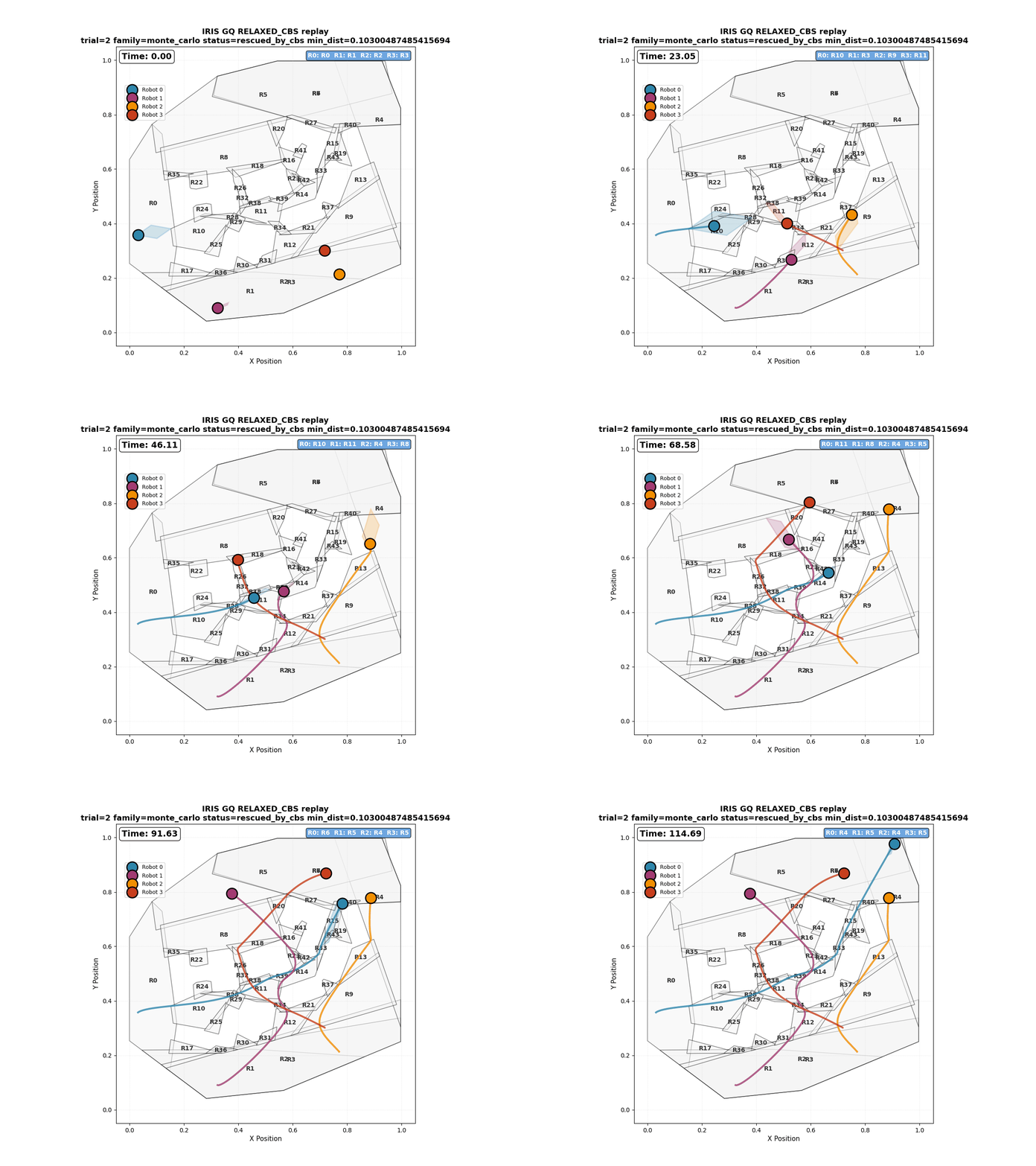
Multi-robot trajectory optimization using a unified STALC (traversal and overwatch coordination) + GCS (Graph of Convex Sets) formulation. Robots navigate through convex regions with Bezier curve trajectories while maintaining formation incentives, overwatch timing constraints, and temporal-spatial collision avoidance. Uses a relaxed-CBS pipeline with candidate path extraction, rounding, and conflict repair.
Hybrid Brain-Machine Interface: Integrating EEG and EMG
2024 - 2025
A hybrid brain-machine interface (BMI) that integrates steady-state visually evoked potential (SSVEP)-based EEG and facial EMG to improve multimodal control and mitigate fatigue in assistive applications. The system dynamically alternates between EEG and EMG inputs, using EEG to detect SSVEP signals and EMG from cheek and neck muscles to optimize control based on task demands.
In a virtual turtle navigation task, the hybrid system achieved task completion times comparable to an EMG-only approach, while 90% of users reported reduced or equal physical demand.
Realtime Natus BCI
2024
Real-time intracranial electroencephalography data streaming and processing system. Built on the Natus Python SDK to interface with Natus Medical NeuroWorks for clinical and research EEG applications. Includes batch preprocessing pipelines, a motor-imagery BCI task using CSP+LDA classification (~90% accuracy), and an EEG visualizer for real-time channel monitoring.
ThermOptik
Filed Feb. 2023 · Published Aug. 2024
US Patent Application (US 2024/0285428 A1): System and method for dynamic temperature control of the ocular environment during ocular surgery. Features a fluid heater interface module (FHIM) with microcontroller-driven precision temperature regulation of balanced salt solution (BSS), including a heating element, temperature sensor, MOSFET driver, and user interface for real-time outlet temperature adjustment.
[Patent]
Assistive Technology Projects
Dan's Crown
Updated artist Dan Keplinger's head-mounted crown, which holds stylus and paintbrush attachments on a carbon-fiber rod so he can type and create artwork with head movements. Improved comfort, durability, and touchscreen stylus support as part of a Johns Hopkins Volunteers for Medical Engineering team.
A Helping Hand
A 3D-printed prosthetic hand designed for Ty, a middle school student born without a right hand. Features a wrist-actuated closing mechanism enabling him to flexibly hold and grab objects. Iteratively prototyped from low-fidelity cardboard models to functional 3D-printed designs, exploring alternative actuation methods including EMG and electronic joysticks.
Adaptive Violin Bow Grip ("BOB")
An assistive device for Rose, a student with muscular dystrophy who has inverted thumbs, making it difficult to maintain a proper violin bow grip. The device supports her hand and wrist so she can learn, practice, and maintain a proper bow grip while playing.
Wheelchair Umbrella Holder
A 3D-printed umbrella holder for M, a student with brittle bone disease whose wheelchair is not waterproof. The holder attaches to her wheelchair and allows her to stay dry independently without needing to carry the umbrella herself. Iteratively tested for strength, accessibility, and compatibility with different umbrella sizes.
© Daniel Wang